Sunday, May 18, 2014

On Pregnancy and Being Pregnant


Tomorrow I will be 31 weeks pregnant. I’ve had a cruisy pregnancy, no complications so far, very few body aches (other than the normal hip and back ache here and there),  and have neither been particularly disgusted by certain foods nor in need of some very-hard-to-come-by item that I’m insatiably craving. I had mild nausea in my first trimester, but it disappeared quickly in my second. I kept mountain biking until about two-thirds the way through my second trimester, and now I bike 15-20 kilometres everyday (slowly, and on flat sidewalks!). I was mixing bike rides with daily 10-kilometre walks, but because of my hip pain have been advised to spend more time on a bike. I do yoga daily, and listen to pre-recorded sessions of yoga nidra a few times a week for relaxation. I strengthen my pelvic floor and that pesky bikini line muscle everyday as well. I eat well, as I have always done, although I do find myself craving meat in pregnancy, which is a dietary switch for me, as for the past 14 years, I’ve rarely eaten any. I’m on track, in terms of weight-gain, for my body type and each time my uterus is measured I am either a bit under or exactly the size I should be for how far along I am. I have decreased my responsibilities as I near the end of my Uni degree and have tapered off my workload with the company I work for.

I feel more compassionate, more empathetic, kinder, more patient, and in general find that the happy hormones of pregnancy fill my mind and body far more than the clashing of irrational, worried thought. I do often find myself tearing-up during sentimental moments in movies/shows, or any advertisement that even mentions a baby, but again this is a sentiment of happiness, though irrational, certainly. I am also quite aware that my intensified attachment to my partner is one prompted by the hormones flooding my body. I want him to be happy, safe, warm (it’s winter here in Canberra), well-fed, well-rested, and spending his time in ways that make him happy. I’m aware that I feel this way because I desperately do not want to raise bub on my own, thus need him to stick around. But the manner in which I express this sentiment means I’m more understanding and patient with him. I’m more encouraging of his participation in the activities he loves most, and I’m constantly cooking nourishing, hearty meals for him (and bub). I am also more patient with myself, although I think this patience was cultivated out of the necessity of my increasingly-uncoordinated body.

Bub’s heartbeat is always within a healthy range. He’s just the right size, although measures a little long and has a bigger head than many of the bubs at the same stage of development (just like my partner, who measures long with a big head). He kicks, jabs and wiggles multiple times throughout the day making it easy to identify his sleeping and waking patterns. And in the early days of pregnancy when I was still getting scans it was hard to identify all his bits because he was constantly on the move, flipping, somersaulting and bouncing on my uterine-trampoline. I have never in my life loved hearing medical staff use the word ‘normal’ as I do now that I’m pregnant. My bub is awesomely ‘normal’.

I have also been overwhelmed by the amazing new knowledge on the female body that I’ve been learning on this journey. It’s just incredible to me how our hormones fill our bodies with chemicals that make it difficult to feel all of the readjustments happening. Our hips are widening, our breasts enlarging, our bellies swelling, skin stretching and yet we feel very little pain (until bub becomes so heavy in the third trimester that even the Relaxin in our bodies cannot temper all of the aches). My midwife also told me that when breast-feeding the mother’s breast identifies bub’s temperature and can change the temperature of her breast milk to warm or cool bub. In fact, if mother is feeding twins and the twins are different temperatures, each breast will produce milk at different temperatures to accommodate. Absolutely incredible stuff, women’s bodies. And the connection that mother makes with bub long before bub’s born is more testament to this incredibleness. Baby's crying-patterns from the moment they are born can be matched to the intonation of their mother’s speech.

And in the midst of all of these incredible changes, new knowledge, my own physical and emotional healthiness and the bonding I am undergoing with my unborn bub and my partner, I cannot help but feel irritated by certain aspects of the pregnancy world.

First and foremost, the consumerism that preys on new mothers and that feeling of needing to do the right thing for the new bub is just disgusting. Whole magazines, dedicated to what $1000 pram you should choose, or the best baby-wipe warmer (I’m not kidding, this is a real product) are modeled by undernourished pregnant woman with tiny, little bumbs (I don’t think they photograph any women in their third trimester) just to make new moms not only feel guilty for failing to spend their life-savings on new clothes, toys, prams, cribs, bassinettes, diapers, wipes, towels, and a slew of products I probably don’t even know about, but these magazines also work to further make women feel self-conscious about the way their stunning pregnant bodies have developed, rounded, and widened into the most naturally beautiful, and purposeful shape.

Unfortunately, it is not just the magazines that put this unrealistic pressure on pregnant bodies. I have lost count at how many times someone has seen my pregnant body, I’ve told them how far along I am and they say something like “Oh, then you must be having twins.” or “You look so much further along than ____ weeks, are you sure you’re not further along?” or “I can’t believe you’re only ____ weeks, when my sister/cousin/friend was pregnant I couldn’t even tell she was pregnant until her last two weeks.” My in-laws even tried out the nickname of ‘fatty’ when they saw me at 28-weeks until my partner very seriously instructed them not to do so. I have continued to politely respond to people that insist I’m much bigger than I should be that, “No, in fact I’m exactly the size I should be. My Dr.s and midwifes, even my pregnancy yoga instructor, all tell me I’m right on track, and so is bub.” But the sheer volume of these sorts of uninformed, obtuse comments combined with hormone-induced, pregnancy-sensitivity make it increasingly hard for me to stay calm during these interactions. The last encounter of this nature, I saw an older Korean fella, whom my partner and I have befriended, for the first time in many months. He asked how much further I had to go, I told him, he looked at my belly and said, “Oh are you sure it’s not twins?” I gritted my teeth, put my hands on bub and said “Ajoshi, I’m not having some tiny Korean baby. I’m a white girl.” And I walked away, angry.

These types of comments are not one-sided, however. I have a pregnant friend (due the day after me) whose bump does not stick out very far from her body. However, each time she’s measured for size and healthiness, everything is normal. Her long torso just makes it hard to see the bump. And she continues to be bombarded by comments from others like “Are you sure the baby’s developing?” or “You’re not even showing, are you sure you’re that far along?” or “You must be having such a tiny baby.” And even though unhealthy skinniness is highly revered in pockets of our unhealthy society, it is not something a pregnant woman wants to hear.

I should mention that many, primarily women who have given birth within the past few years, comment on how healthy I look and seem, and how fantastic my bump is coming along. I cannot help but think that their exposure to the culture I’ve just described is the impetus behind their kind words. I am certain to only focus on the healthiness of other pregnant woman after my own experience.  

Thursday, June 2, 2011

Hospitality

For 10 years of my life, I have worked, in some way or another, in the food industry. Five years ago on my first day of teaching English in Seoul, I kept asking myself what I was doing in a classroom full of rich Korean primary students when studying, writing, and coffee serving constituted my true expertise. Now those classroom desks have turned back into dinner tables as I find myself working at a five star restaurant four nights a week.

I've returned to Australia, this time with permanent residency in sight, and am therefore in a bit of a transitional phase between overseas traveling and life resettlement. In an effort to hold onto to as much of those sweet Korean savings from all my years of English teaching, I sought out a some casual work for which I am extremely qualified, waitressing.

When young and poor, waitressing can be quite satisfying (particularly in North America where politeness and efficiency directly translate into earned tip money). However, now that I'm nearly 30 and have a bit of cash in the bank, waitressing, though certainly socially enjoyable at times, can occasionally seem trivial at best and down right nasty at worst.

I struggle to tell the beginning of this story, as I am human, and like all humans do not wish to make myself look bad. But this story begins with 29 year-old me, 10 years experienced me, casual waitress me spilling two glasses of wine (one red, one white) all over the khaki pants of a 20 year-old American fella visiting Cairns with his folks. Fortunately, the spillage was restricted to the young fella leaving his parents and younger sister dry for their Five Star Aussie Dinner. My young victim reassured me that his ruined pants were of no consequence as he bought them at Target years ago and cared less if they ever returned to their natural color. His mother, despite her dryness, was not as amicable. She looked to him in horror, and then at me in disgust.

We moved the family to the neighboring empty table, brought out soda water and napkins for the spill, re-served their wines, and treated them to house coffees and desserts. I, however, continued to feel guilt-ridden. Although the family was not seated in my section, I repeatedly made my way over to them, trying to be as pleasant as possible, making conversation to ease the air of my messy mistake.

Through all this conversation, I revealed that I'd previously lived in South Korea, to which they revealed that the plastic surgeon father thought the South Koreans he met in his profession were unhappy and unpleasant (though I doubt most folks, regardless of nationality, looking to change the way they feel by reconstructing their faces find real happiness in anything). They then talked about their safari to Africa as being the only trip superior to their current holiday in Australia. To which, I explained that I'd really like to do some volunteer work one day, possibly in Kenya with a Maasai community. And at this point, the mother asked for my age. When I told her I was nearly 30 she asked me "And so, what does your family think of how you haven't started real life yet?"

I nearly choked on my surprise. Then genuinely smiled from my small chuckle of disgust, and said, "This is my real life. And I'm really happy." At that her wine- stained son said, "Yeah mom, happy. She's happy."

These sorts of nasty moments make working in a customer-oriented profession, like hospitality, quite painful. However, I do find a great deal of satisfaction knowing that my life decisions make this sort of an encounter unique. Imagine living in a world where everyone thought and spoke like this woman! Certainly that world exists and I'm happy to have found a way around it.

Monday, January 17, 2011

You Spit, I Spit, We Spit


I've adjusted, even acclimated to most of the big, everyday cultural differences between the East and the West (or Korea and the West, at least). I love Kim-chi. I don't mind the fishy smell that wafts through all of Jeju. Sometimes, I throw my toilet paper into rubbish bins, instead of the toilet. I can patiently sit through hours of meetings where everyone is speaking Korean, talking about the meeting we need to have after this meeting. I usually don't scream at people when I drive through chaotic traffic (though I do beep my horn a lot!). Being bumped into from all sides on a huge sidewalk with only a few people waking down it usually just makes me laugh. Witnessing a mother helping her young son pee into the drain on a busy road seems normal. And being served a meal full of spam bits when I explained in Korean that I don't eat meat, feels more like my fault for failing to request the spam also be omitted from my meal.

But I'll never completely adjust to the spitting. Korean men, especially older men, spit anywhere and everywhere they please. They spit on sidewalks, the spit on the beach, they spit in stairwells, and occasionally they spit right at your feet. At least, these ajoshis (Korean word for older man) give ample warning before they soak your sneakers. It seems impossible to spit in Korea without first deeply sucking air through your nose and throat being sure to collect all the snot that may be lingering in any of your nasal passages. Once you hear a long snorted inhale it's best to step away from any old man in your proximity.

Spitting is not a purely Korean thing. I have my own stories from Thailand, Malaysia and Hong Kong. I've heard similar stories from friends' visits to basically all Asian countries. At least in Hong Kong, however, there seems to be an attempt to limit this snotty cultural aspect. Hong Kong's water fountains, bathrooms, metros, and parks post "No Spitting Signs" (as seen below) with hefty penalty fines.

Korea seems years away from this sort of cultural awareness. A few weeks ago, I stood at a intersection waiting for the light to change when I heard that disgusting, forewarning, sucking sound behind me. When I looked back, an angry-looking ajoshi released his snotty prejudice right at my feet. I couldn't help but think that he intentionally aimed at me. And so was confirmed of this, as I stepped away from his spit and flashed him a little smile. To which he began sucking any remaining snot deeper into his throat readying it for another launch at the white girl on the street corner. But I managed to load my own loogie and spit at his feet before he got off another round. When the crosswalk light turned green in the opposite direction I was headed, the angry ajoshi cowardly retreated from our spitting war, and headed across the road.

I was making my way to the Lotte Mart kitty-corner from our spitting battleground, and so had to wait for a couple of crosswalk lights. When I finally made it to the entrance of Lotte Mart, I heard that same sucking sound begin again. I turned around and spit (a weak, snotless, unprepared spit at that) just as the angry ajoshi took aim at my feet once again. His proper loogie landed just next to my shoe, and I looked up at him, spat another weak, formless spit and yelled at him to stop spitting at white people. He grumbled something that was definitely not in English and probably not in Korean.

I suppose I should be a little embarrassed for participating in spitting combat with an old, racist Korean man. But honestly, I'm far more embarrassed of my weak, snotless, formless spits than any youthful disgrace of an elderly person.

Monday, November 15, 2010

Car Free Day

While South Korea may not make the standard tourist's top ten list of must-sees, we shouldn't deny its modest allure. Estimates of around 250,000 foreigners live in Seoul alone. A small percentage of them are English teachers, who, like me, thought they'd sign a one-year contract, bank the money, and never return to Asia's Land of the Morning Calm. And yet, here we are, heaps of us.

Undoubtedly, foreigners stay in South Korea for variety of the country's positive aspects. Its cleanliness, however, is not one such aspect. South Korea's current pollution issues include air pollution, acid rain, and water pollution from sewage discharge and industrial effluents. This country consistently ranks in the top 20 (often top 10) of most polluted nations in a variety of categories from air pollution, CO2 emmisions, water pollution, to nuclear waste. South Korea is the world's fastest growing nation, and its air, water, and wildlife have suffered great costs in the name of capitalistic development.

Environmental damage often raises environmental awareness among a nation's public, and South Korea is no exception. For example, Korea's large shopping stores, E-Mart and Lotte Mart (Korea's K-Mart and Wal-Mart), have stopped supplying shoppers with plastic bags for their groceries. (For a fee, shoppers can now buy paper bags.) However, buying products from these stores free of excessive plastic-wrap is essentially unavoidable. More specifically, nearly all food and products sold in E-Mart and Lotte Mart are packaged individually in disposable plastic, then repackaged in a disposable box and wrapped once more in disposable plastic. The ban on giving plastic bags to shoppers is a step in the right direction, but it's quite obvious that the core motivation behind banning plastic bags is lost on the corporation and many of the consumers alike.

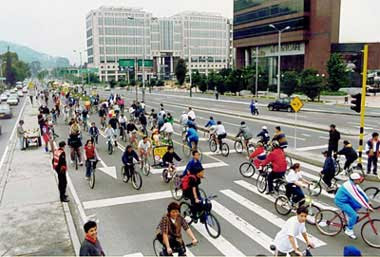
Jeju Island's 'Car Free Day' celebration reeks of this same good-intentioned, misunderstood sentiment plaguing South Korea. This year (on November 12) Jeju Island celebrated it's first 'Car Free Day.' Those familiar with 'Car Free Day' are certainly referencing famous images from cities like Bogotá, Colombia, where full city streets are completely empty of cars, as nearly every citizen walks or rides bikes for the entire day. Certainly Bogotá's 'Car Free Day' success was not born over-night, and we cannot expect Jeju's first 'No Car Day' to resemble anything like an entire car-free city.

Bogota, Colombia's Car Free Day

And while I don't have any unrealistic expectations of Jeju's first 'Car Free Day' success I do think people should just be honest about their participation in the event. Last week, as November 12th neared, I imagine that news-gathering principals and vice principals alike heard word of the upcoming event, and so instructed their teachers and school staff to participate in 'Car Free Day'. That morning, I walked through the carpark of my school, and saw a mere 3 cars parked in the massive carpark (I teach at Jeju's largest elementary school, which is attached to a middle school, both of which share this parking lot). Forgetting that is was 'Car-Free Day', I just assumed I was a little early for school (as I am usually a little late). Later, when I realized that it was 'Car-Free Day', I was quite impressed with the teachers and staff at my elementary school for taking it so seriously.

That afternoon, when my partner came home from his school. He too told the story of the empty parking lot he noticed as he parked his motorbike, thinking, 'Sweet, maybe everyone's off on a field trip today!" Yet, when he walked in the school, it was buzzing as always. He asked his co-teacher why the parking lot was empty and she told them that all the teachers had to park in the neighborhood up the hill from the school, because it was 'Car Free Day' and the principal told them not to drive to work. Essentially then, these teachers had not only driven their cars to work on 'Car Free Day', many of them had used extra gas to drive farther uphill in order to secure a parking spot that was far away enough from the school to appear as though they'd walked or used public transportation to arrive at school. And all in order to appease the principal (who, in all likelihood also parked his car up the hill)!

I can only assume that the teachers at my school also hid their cars in the neighborhoods around the school. Saving-face is a Korean malady, that, for the sake progression in this country, I can only hope is one day cured (actually cured, not just given a shot in the bum told to 'take a rest').


Friday, July 16, 2010

Showing Off

Yesterday afternoon, when the incredibly pleasant two Korean teachers, with whom I share the English office, received a phone call that caused them to pass the phone between the two of them, and make anxious, gloomy-looking faces in my direction, I knew something ridiculous was a-brewing.

"Ah-di-ael, ummm, sorry, but the, ummm, the director of the POE won the election in June."
"Riiiiight?"
"So the Educational TV in Jeju will do a news story about him. And he really pushes the development of English."
"Riiiiight?"
"And so they want to video tape your class tomorrow to show how he is doing a good job pushing the English curriculum."
"That's about right."

I suppose it's fair enough that the director of the Educational Office in Jeju wants to show off Jeju's best elementary school full of fluent English-speakers. Not only are many of them fluent in English; their parents are Jeju's richest; most of them have been overseas; nearly all of them take English classes 5 days a week at local hagwans (privately-funded 'extra' schools), which many of them have attended since their toddler days, learning Korean and English simultaneously. I suppose that's fair enough. But honestly is the wealth and opportunity of Halla Elementary's rich families any reflection of a job-well-done on the part of the re-elected director of the Educational Office? Why do I even pose questions like this anymore, one would think I knew better after all my time in Korea.

Today was my final day of Friday classes, meaning that my lesson plan outlined 5 minutes of 'Good mornings,' 5 minutes of 'Simon Says,' 25 minutes of 'Review Jeopardy,' and 5 minutes of 'Good-byes.' A lesson plan, surely not adequate for showing off Jeju's richest and finest young English speakers. My co-teachers, aware of this, argued my case to the Vice Principal, suggesting that the TV station use my prepared videoed class from weeks before. And suggested as well that a plethora of videos, including videos of last year's award-wining-teachers (of which I am not) sat in the Educational Office.

To this they answered, that the re-elected director of the Educational Office (let's call him Mr. Kim for simplicity, and for the overwhelmingly likelihood that his name is indeed Mr. Kim) insisted upon making a new video, shot by real TV cameramen, with a real TV camera.

"So, Ah-di-ael, sorry, but we have to make this video. It is okay?"
They don't really mean, 'It is okay?' They mean, "Ah-di-ael, you have no choice but to make the video because we live in a polite hierarchical society where we have to do many nonsensical things just because people in higher positions than us have requested it. But we cannot demand it of you with our words because we are too polite."
"Sure, I'll do the video, but I'm not going to plan anything new. I'll just use one of my old lesson plans, and those poor students in 5-2 will have to repeat a lesson, instead of playing a review game."
"Yes, that's a good idea!"
Is it, really?

This morning, when I arrived to school, my co-teachers informed me that all my other classes were canceled, because they were unaware of the arrival time for the camera crew. We were to sit and wait until we heard that the camera crew was coming. Also, they added that the class needed to be filmed in the English room. A high-tech, expensive, poorly designed classroom with long desks and chairs too big for children, that I opted not to use all semester because of its clumsy structure.

As I was rearranging the clumsy room this morning, I couldn't help but laugh at the ridiculousness of a re-elected director of the Educational Office trying to show off the English ability of students who didn't learn the majority of their English through the public school system. And doing so by forcing a non-award-winning English teacher to make a professional video on her last day of 'Jeopardy Review' class, which she then changed to reteach a prepared lesson to children in a clumsy room she'd never used.

And furthermore, since all my other classes were canceled, no actual English learning took place in Halla Elementary this morning, and all for the sake of showing off yet another Mr. Kim!


Friday, April 23, 2010

Flying...

I currently love overseas traveling. When I was younger, I even loved the physical airplane ride. When I was 19, and could curl my little 19 year-old self into a ball and sleep for the entire 10 plus hours with my head gently resting atop my bent knees through the beverage service, the dinner, the late night beverage service, the continual water offerings, the breakfast, and even the landing, I just couldn't understand how anyone could loathe flying.

Even into my early twenties when I couldn't sleep for the length of of the entire plane ride, I'd find a good movie to watch on the small screen placed on the backs of all seats; conveniently economy-class airplane technology was developing alongside my ever increasing inability to sleep in a curled up ball. And as long as I remembered to tell the travel agent to order veggo meals for me, the dinners were never as awful as popular culture purported. After my hot veggo dinner and complementary bottle of wine for one, I could easily fall asleep to whatever movie I'd chosen, only to be awoken by the smells of food carts full of breakfast, and at least one veggo breakfast for me.

I've not taken residence in the states for six years now, so in order to return home, it has to be an international return home. And since nearly all of my friends here in South Korea are also Native English Teachers, oceans away from their families, international flying is a common, well-researched, topic of interest often discussed around dinner tables. The general consensus reassured by every one of these conversations is that all airlines owned and run by any North American is inferior to all Asian airlines in nearly every possible way.

Airport services. Many Asian International airports have massage rooms, massage chairs (some are even FREE massage chairs), movies to watch, shower rooms, and some even have exercise rooms for the long layover-er. Oh, and these services are offered to everyone, not just those lucky enough to carry some Super Elite Frequent Flyer card with free entry access to places as choice as Narnia. Internet in many Asian airports is also free, and if not free, at least it's an affordable way to spend an hour or so of your time. I once accidentally spent $25.00 of my last $45.00 US Dollars in LAX within hour 1 of my 7 our layover using a ridiculous priced internet service on my laptop (In Korean airports, even for domestic flights, you can use airport computers for free internet services).

Bag checking. On my last trip from Chicago back to Korea in February of this year, the large fella working at the Baggage Check looked at my things, as they made their way through the rubber flaps on the secure side of the conveyor belt, "We got another one who can't listen and follow directions," he said. "Excuse me?" I asked, "Have I done something wrong?" He gruffly explained that just moments before he'd yelled to everyone that they needed to keep their shoes OUTSIDE the buckets. I irritatedly apologized and explained that it was really hard to hear anything as so many things were being yelled at us back there. Furthermore, it's difficult to know just what to do, as every American airport seems to have different rules, though the same sense of condescending righteousness among its workers. As I grabbed the rest of my things, anger boiled up inside me, and I couldn't resist telling him that I didn't appreciate him treating me as though I were a child, and that I'd done a fair amount of International travel, and no other nation had airport workers as rude as the Americans. He then told me, "That's cause American airports do it right." Riiiight, I thought.

On a recent weekend trip to Seoul from Jeju, I had failed to take my mini swiss army knife off my key chain, and as I didn't check any baggage, it was scanned, identified as dangerous and I was asked by a very pleasant employee to go back to the counter and check it through. When I showed him my boarding pass and told him that I didn't have enough time, he escorted me downstairs to my gate, handed the knife to a steward on my flight, who put it in an envelope and then assured me that I'd get it back in Seoul. If only I could have expressed in Korean that the 'American airports do it right' then these incredibly helpful, patient Korean airport workers could have seen error of their ways.

Service. Just last weekend I had to change my flight departure date for a domestic flight from Seoul to Jeju, and because the Sunday flight was originally more than the Monday flight that I was changing to, there was no fee at all. Had my flight changing happened in the states, I'd be sure to pay a fee, regardless of price difference, possibly even more than the price of my ticket.

Smiling, attractive stewards, stewardesses and counter people. In Asia, only happy people, or people who fake happy well, are allowed to serve you on an airplane or in an airport. I'll refrain from describing the physical appearance of most of the stewardesses on North American international flights, but let's just say, if they smiled more I wouldn't notice just how fat they are.

The days of curling up in a ball and sleeping for the entire course of an international flight are over for me. I increasingly find it difficult to sleep much at all on flights these days, and courteous, smiling stewards and stewardesses are becoming more and more important to me. One day, when I move away from Korea and enter life back in the West, I'm sure I'll sorely miss Asian airplanes, airports and staff.


Tuesday, January 26, 2010

Korean Traffic Pandemonium


I’m certainly not the world’s best driver. In my first few teenaged years of licensed-driving, I crashed the front of my car (well, the car my parents let me drive) into a brick flowerbed on a rainy slippery afternoon; backed the old thing into massive trash receptors denting my trunk; and pulled out in front of a friend’s mom’s van the afternoon of junior year prom, forever sealing the driver’s side door, forcing window-climb entries a la The General Lee from ‘The Dukes of Hazzard.’

However, in my 12 years or so of driving, I’ve not hit, smashed, slid, hydroplaned, fender-bendered, or even bumper-tapped anything since that wayward junior prom afternoon. This dramatic drop in minor accidents can be attributed almost exclusively to the fact that I stopped driving much past my high school days.

Eleven months ago, however, after living on Jeju Island for a year, I bought an old, beaten, scuffed-up, gas-guzzling car from another foreigner. And while I cannot say that I drive the beast regularly (as I also own and drive a small 125cc motorbike, which is better for gas, money, convenience, and anxiety), I can say, that when I drive, I am regularly stressed, irritated, fist-clinched and spouting a variety of cleverly-phrased (or I think so, at least) curse words!

There are various reasons attributing to Korea’s chaotic driving culture; for example, its relative short history. Cars were not a family staple in Korea until about 20 years ago. Now, every family has at least one car, and at least one driver, possibly self-taught, and almost certainly not a product of heavy childhood car-culture like that found in the West. Korean adults today didn’t grow up climbing in and out of cars, like most Westerners. My grandparents knew how to drive, and so taught my parents, and so taught me. I had 2 generations of driving-knowledge passed down to me in my youth, whereas many of the adults driving in Korea today possibly had no car experience before they began driving.

Furthermore, and possibly also because of its brief history, driving common sense is that of fiction here in Korea. I imagine that most Koreans were taught to drive with one hand so as to keep their other hand free for phone duty. I’ve seen a woman with her baby on her lap, driving her car at night, dome light on so she can see the lip liner she’s applying, with her cell phone wedged in between her shoulder and ear. Not only is it still legal to talk on your phone while driving, the Korean government just passed a law maintaining the rights of taxi drivers to keep satellite TVs on their dashboards, so as to keep the taxi drivers entertained when without a fare, despite a few crash-related deaths due to distracted, ‘entertained’ taxi drivers.

‘Blind spots’ has no translation in Korean (at least that I know of), as driving instructors have no lectures on the subject. It is common to drive in Korea and have the car in front of you completely cut you off, for if they cannot see you in their mirror, you do not exist! A friend of mine relayed a story about a young Korean woman, riding in the passenger seat of a Westerner’s car. My friend was sitting in the backseat, and as the Western-driver, when changing lanes, kept checking her blind spot for approaching cars, the Korean woman also turned around, with a very confused look on her face. When my friend and the Korean woman were alone, the Korean woman confided her confused question, “Your friend is a good driver, but why does she keep turning around all the time? What is she looking for? She should keep her eyes on the road in front of her.”

In Korea, it is perfectly normal to park your car, on a main street, if you need to run into a shop, a bank, or your home (and nap for hours). It seems that if one puts hazard indicators on, it’s no hold’s bar on any parking and driving laws one may violate. Within my very first hours of arriving to Korea, a Korean co-worker picked me up from the airport, and drove me into Seoul. When we missed our exit on the massive interstate, he simply slowed the car a little, pushed on his indicators, and reversed from 60kph on the interstate to make it back to our exit.

To further compound this young, uninformed driving culture, there is a complete lack of law enforcement where common (though serious) driving violations are concerned. When traffic laws like running red lights, parking on busy main streets, pulling out across three lanes of traffic to turn, u-turning on main roads into on-coming traffic, (the chaotic list could continue forever, I fear) are infringed and the local police happen to be there, they do nothing. A friend of mine, while sitting at a long, quiet red light, checked both directions of traffic and slowly pulled through the light, only to realize that she’d not checked the car next to her before doing so. When the cops watched as she ran the red light, they whooped the siren for a moment, and then remained stopped at the red light, as she slowly drove away.

A young driving culture and a lack of law-enforcement can account for a certain degree of the Korean traffic pandemonium, but something must be said for the uncanny similarities between their driving and the way Koreans walk, line-up, and organize themselves in open spaces. In the same way that it is not rude in this culture for an adjuma (an older woman) to bump into your back, elbow your side, groan ‘Bali Bali’ (Faster!) at you then speed past you as you try to enter the front doors at Lotte Mart (Korea’s Target), so too is it socially acceptable to side swipe someone’s parked car, knocking their side mirror off, and scuffing their doors then simply drive away, guilt-free.

Korea’s most effective driving/parking solution to the seemingly unsolvable chaos, is that of posting a telephone number on the dashboard of all cars. Since the police rarely ticket illegally parked cars, and tow-trucks cannot tow un-ticketed cars, the only way to move a troubling vehicle is to ring the person it belongs to, ask them to come outside, and park their car elsewhere!

If only this were the status quo of America, 1998. I very easily could have left my car in that brick flowerbed of my neighbor’s yard, ensuring my phone number could be easily viewed from the windshield and awaited their pleasant phone-call request for my car's removal!


Wednesday, December 2, 2009

Rebel Hair Woe

I had this wee ingrown hair in my armpit that I noticed about a month ago. It didn't really hurt, and I wasn't too worried about, though I did try to squeeze it out and even subjected my boyfriend, tweezers in hand, to have a go at removing the little annoying hair. Still, after reading a bit on that new thing we call the Internet, I learned that ingrown hairs really don't get better on their own. Either they always stay the same or they get infected, worsen, and cause heaps of problems. So in my proactive, 'I don't want heaps of problems later' manner, I used one of my mornings off work to get the little curly fella checked out.

Most doctors in Korea speak English decently (though I have been told by an acupuncturist that my neck pain is 'cereal'). For this particular affliction, however, I wanted to clearly explain my problem and ensure he knew what to do for ingrown hairs. Furthermore, if he was sick that day of med-school where they explained ingrown hair procedure, I knew of a great website we could read together (in English) that outlined, what seemed to me, a very easy method of exfoliating, tweezering and yanking to rid my armpit of her rebel-hair woe!

Unaware of skin doctors capable of speaking this advanced level of English, I headed toward the foreigner clinic inside a hospital not too far from my house. When I arrived for my very first visit to this English-welcoming clinic, I was disappointed to find that the nurse couldn't say much past, "Your name?" and "Your ID card?" Though she did try her best, and continued to repeat "Dok-tah la-bol-la-tol-li," which obviously means that the doctor is in the laboratory, though I was having troubles discerning this obvious statement as I sat in front of her, slowing duplicating her constant repetition. "Dok-tah la-bol-la-lol-li?" I said. Now, it was my turn to sound stupid as I explained in my poorly spoken, pigeon Korean, that I was sorry, but I didn't know what she was saying. She smiled, picked up the phone, dialed a number, huffed a bit, set the phone down, and asked me, in Korean, to wait.

40 minutes later, she handed me the phone.
"Hello?" I asked.
"Hi. I am the doctor."
I explained everything about my renegade armpit hair. And he explained everything about 'Dok-tah la-bol-la-lol-li.' He said, "Ok, well I am in the laboratory all day today, and will not come to the foreigner clinic. So I suggest you go see a skin doctor at another smaller clinic."
"Rightio, Doc, but I came here because I wanted to communicate clearly in English."
"Yes, well I suggest you go to a skin doctor in another clinic, who speaks English." explained doctor obvious!
"Sure, well do you know of any English-speaking Skin Doctors?" I asked.
"Ummmmmmm no. Do you read Korean?"
"Yes, but how will I find a skincare clinic with a doctor who speaks English?"
"Ummmmmm, I suggest that once you find a clinic, go inside and ask the doctor."

I laughed out of frustration and at my obtuseness, told him I could figure things out on my own, and hung up with the ever-so-helpful Dr. Obvious. I left the hospital angry, and marched back toward my house, where I remembered seeing a building full of different specialized clinics. My cell phone's Korean/English dictionary translates quite a bit better from Korean to English, so as I stood in front of the 5 story building, I typed in the names of each of the clinics. Floor 5 was a skincare clinic. Golden. Now to ask the question of English!

Luckily enough, on my very first 'find an English speaking Skincare Doctor' attempt, the doctor spoke English, as did one of his nurses. So he set me up with some minor laser surgery, and fried that rebel curly-hair out of her cyst-like home! During the extremely brief procedure, a nurse stood above me with a hose to suck out the smell of burning flesh. However, the hose didn't quite reach to my armpit, so she placed it next to my nose, ensuring that neither the doctor nor the nurse could capture the alluring whiff of my blazing armpit, but failing to prevent the smell from wafting up my nose! Fortunately, I endured only moments of the quesying odor, as laser-burning small ingrown-hair cysts takes merely moments.

Relieved that I no longer had to breath in my own burning flesh, I redressed, and made my way to the check-out counter, where I paid my whopping $12 bill. Realizing, that despite the frustrating conversation with Dr. Obvious, searching for an English-speaking doctor on my own, and inhaling my own singeing flesh, the morning's events were far more pleasurable than they could have been back home. All that hassle is worth a mere $12 bill. With seriously flawed healthcare 'reform' bills back home, I'm happy to be in government-funded healthcare-for-all (even for English teachers!), Korea.


Monday, November 23, 2009

Hello Mr. Kang!

Korean children study, a lot. Fortunately enough, for those of us looking for jobs here in the 'land of the morning calm', Korean parents force their children to study, a lot. Unlike back home, where after school activities typically include playing some sport, socializing with friends, walking home, riding bikes around town, and so forth, Korean 'youngins' study anything and everything from robot building, to playing musical instruments, to English, to Maths, to Lego building (in English!). Hagwon is the Korean name for such after-school private institutions, where little Korean kiddies flood, between that last school bell, tae-kwon-do practice, dinner, homework, and sleep. Hagwons even offer Kindergarten (English Kindergarten) classes for Korean children as young as 3 years-old (western aged 3, anyway).

Although I work for the public school system here in Jeju, my job is more similar to that of a private institute. The Jeju government has established 'The Centers' in an attempt to offer an alternative to Korean families, who do not have the funds to send all of their children to expensive English hagwons. The Center is free for all students, ranging from 1st graders to middle schoolers, and even adult students. My job entails then, teaching a maximum of 16 children (or adults) per class, four times a week for 50 minute classes. The differences in English level I see each day ranges from 2nd graders who are happy to ask each other 'How are you' and giggle when they scream in excitement, 'I'M HAPPY!!!' to middle schoolers who sift through English newspapers in order to complete my assignments. The Center has been a fabulous place to work for my first two years in Jeju, but it, like all things in Korea encompasses some annoying aspects that can be truly hilarious.

A couple of weeks ago, the second in command here at the center, Mr. Kang, was strolling the hallways during our last class hour. Mr. Kang is a smiley, silver-haired, short Korean man, who, despite working in the government-funded language institute, can speak no other languages besides Korean. Before beginning class, I was showing 2 members of my whopping 6- student-class a video on the internet about polar bears. Mr. Kang walked past my open door, peered in suspiciously, and looked at his watch, signaling to me, that he thought I should be teaching now, instead of showing my students a polar bear video. I waited a few minutes more, as 2 of my students had not arrived to class yet, and when the last of my middle schoolers arrived, I asked (surely because of Mr. Kang's disapproving eyes) that she close my door.

We began class chatting about their all-school, all-subject exam day each of them had just finished; how they thought they'd done, if the tests were difficult, if the English section was difficult and so forth. Ji Eun, the chattiest of my students was explaining how they could check the answers to their tests after school, so everyone pretty much knew how they'd preformed when mid sentence, she noticed the the window behind my white board opening and she said, "Ummm Arielle Teacher, that window's opening, mind if I check out who's behind there?" I smiled and said, "Go for it!" Ji Eun crept up below the window, slid the white board to the side stood up in front of the window, and yelled 'boo!' Her face quickly turned to terror, she shut the window, started laughing uncontrollably, and quickly made it back to her seat. She pointed toward the door. "Your boss, your head boss!" She said. I opened the door, saw Mr. Kang, smiled and said, "Hello Mr. Kang! If you'd like to observe the class, please have a seat. We'd be happy to have you in here." Certainly understanding little to nothing of what I said, he shook his head, smiled out of embarrassment, and quickly turned the corner out of my sight.

A few minutes later, Mr. Kang was back to his old shinanigans, opening more of my windows. This time, at the rear of my class, behind the students, in the direction I was facing, he slid open another one of my windows. This time, however there was no white board to hide his sneaking little face. When our eyes met, I repeated my offer, "Really, Mr. Kang, if you'd like to watch the class, please come in, and have a seat." He uncomfortably laughed again and quickly slid the window closed.

I know there must be some cultural, generational, possibly even gender differences here that make it very hard for me to understand the motivation behind Mr. Kang's sneaky window sliding! But, I reckon I don't even want to completely comprehend his class checking impetus, after all, these diversities and misunderstandings make for such sweet stories!

Friday, November 20, 2009

Jogging along the streets of Jeju...

I, like all amateur runners, have a love-hate relationship with jogging. Every time I go for a run, I have to force myself to strap-on my shoes, get my hip-hopy, loud, fast, energetic playlist ready, fasten a watch with numbers large enough for my eyes to read at a bouncing distance, lock my door, store my key in my sports bra and hit the pavement at a pace so slow walkers have occasionally passed me. Despite all this struggle, however, I continue to run. I've been amateur-ally running for nearly 10 years now, and have taken the occasional monthly break, but always return to forcing myself out that door and hitting the pavement.

My relationship towards being a runner is a little more straightforward. I simply don't like it and I refuse, to look like a runner. My sportswear (for every athletic activity I participate in) consists of old, holey, black leggings, sports bras with little to no elasticity, a tight Adidas tennis dress that I found for $5 at an op-shop a few years ago, and until a few weeks ago, running shoes purchased nearly 5 years past. And as the winter has crept its chilly breath into the air, my running attire, with each old layer has, I fear, only become more ridiculous.

Last year, Dunkin Donuts, here on the island, had a promotional Christmas package, where lucky customers could purchase these enormous earmuffs equipped with headphones inside the white fluffy muff. To accessorize accordingly (and in a very Korean fashion), the earmuffs also sport a small chord-storing, bum-less, meant-to-be-adorable (blah) teddy bear attached to the chord. The earmuffs also have sewn into the sides, with golden threads, a decorative DD, sure to alert any jealous onlooker as to the origins of the wonderful multi-purpose earmuff-headphones! I was lucky enough to receive this incredible invention last Christmas, and sport them enthusiastically in these cold winterly days, as I jog along the streets of Jeju.

In Jeju, street joggers are not a common site. Joggers, and walkers stick to the sidewalks of a few designated 'running' and 'biking' roads, or jog around the tracks found in most school yards. I've reasoned that most of them drive to these roads, park their vehicles nearby and walk or run back and forth along the socially accepted jogging paths, as it's hard to spot Korean runners and walkers anywhere else but on these roads and tracks. And one need not search carefully to discern a Korean jogger or walker from ordinary pedestrians, as Koreans are prone to wearing the exact same attire when out exercising. They sport long, dark-colored, brand name trackydaks accessorized with clean, white, reflective, brand name runners. In the winter months, many Korean joggers and walkers wear large scarves and winter beanies, though some still sport the brand name cap.

Needless to say, I look different. Even if my hair weren't blonde, my large eyes weren't blue, and my legs weren't a bit longer than the average Korean woman's legs, I look different. I jog on un-designated jogging roads, paths, and sidewalks. I wear earmuffs so big that when walking through a small door frame, I have to turn my head sideways to enter! I don't wear trackydaks, ever. And brand name clothing, unless purchased at an op-shop, ranks pretty high on my list of things most wrong with people in the world today. And when you look different in Korea, people, all people stare.

So my love-hate relationship with my amateur running hobby is further compounded here in Jeju by those curious onlookers unaccustomed to seeing anything out of the ordinary. What I want to do is run like a maniac, screaming nonsense at the top of my lungs, chase them down the street, and then give them a big hug and sloppy kiss. But I continually fight these urges, occasionally making a 'what the flip are you staring at?' face. Sometimes I even pull my shirt over my head or cover my face with my hands, and then run home...faster. At the very least, jogging along the streets of Jeju has improved my pace as I angrily race away from the numerous confused stares!

Monday, November 9, 2009

Jeju Fortnightly


I write one pretty insignificant, pretty short article twice a week for Jeju Weekly, the English newspaper here on the island, that despite its misleading name, publishes just fortnightly. 'Newspaper' is possibly another misnomer, as the glossy, all-colored print, rectangular paper appears more like a magazine full of uncritical content that merely praises the positives aspects of life on Jeju. Please don't misread my cynicism, there is an abundance of brag-worthy content to report about on the island, as it is undoubtedly beautiful and full of exciting tourist-friendly activities. And I'm more than happy to venture off every other Saturday, to a new part of the island with a Korean translator to meet and greet quasi-famous Jeju locals like traditional pottery-makers, artists, organic farmers, singers, orchestra members and so forth. But a real 'newspaper' would investigate and run stories that showed the grits and guts of the island juxtaposed with its flowery tourist exterior. So magazine it is then, I write one pretty insignificant, pretty short article twice a week for the English magazine, misnamed Jeju Weekly.

A couple weeks ago, Jeju Weekly offered me something a little less insignificant: the chance to write a cover story. And I got greedy and accepted. I enjoy writing for the paper because it adds nearly no extra stress to my life and presents opportunities for me to learn new things. But with fame and glory comes responsibility and hardship, right? I had scheduling and rescheduling problems with this story, emailing problems, incompatible software issues, and semi-frequent guilt trips via email from my contact at the paper.

The Tuesday before the deadline, I decided to outsource all the Jeju locals that could possible help me organize an interview with a tangerine farmer before my Saturday morning deadline. Help came via Rae Won, an adorable, petite, mother of two, who used to attend my adult English class that I taught out in Seongsan (farm country) last year. When she replied to my desperate-text pleading for help, she said, "Thank-you, Arielle, for remembering me to ask me to help you! I have a friend organic tangerine farmer!" After reading her text message, all the week's irritation immediately dripped away. Whatever annoyances I may have felt early faded with the prospect of spending a morning with Rae Won and her organic-tangerine farming friend!

So in my cover-story debut, this fortnightly edition of Jeju Weekly, should run my pretty insignificant, pretty short cover story on Jeju's tangerines, thanks to a woman who thanked me for asking a favor of her!

Tuesday, October 27, 2009

A Symphony Inside a Cave within a Cave...

Jeju Island is the largest volcanic rock in the waters south of the Korean peninsula, but it does not stand alone. Surrounding Jeju are many smaller, some inhabited, some not, islands that can be reached by a short ferry ride from Jeju's coast. To the East of Jeju's shoreline sits Udo, or Cow Island in Korean. Locals insist the island, when viewed from Jeju's shores appears like a cow swimming toward Jeju. In my many trips to and from Udo, I've not yet seen the similarity between it and a cow, but I don't eat as much kimchi as the locals, so possibly I lack serious perspective!

Udo is a small, flat island with one giant hill on the eastern side of the island. Under this rocky hill lies a large cave, named Dongan Gyeong-gul charmingly dubbed, ‘whale nostril cave’ because of its large nostril-like shape, accessible only during low tide. After trekking across a black sandy beach, entering one small cave and exiting through a tiny gap at the cave's rear, one must climb over slippery boulders where ocean waters splash below to reach the entrance of Dongan Gyeong-gul.

The trip is well rewarded any day, as the cave is quite interesting to investigate, for any of those naturally inquisitive explorer-types. But once a year, the reward is even more special, as the Jeju Symphony Orchestra performs inside this unique venue. Now, Udo's Whale Nostril Cave is no Red Rocks or Carnegie Hall, but it does have a special small feeling about it. The cave's wide nostril exposes open sea waters to one side and hides bats and other cave dwellers to the other deep, darkened side. Though the symphony included a mere 7 members accompanied by a 10 member choir, the sounds deep within the cave echoed beautifully.

However, as is the culture here in Korea, even events as naturally appealing as a small symphony orchestra playing inside a cave within a cave, the event lacked that certain all-natural intimate feeling. For every symphony member, there were at least 2 camera men. They stood in front of the crowd members, moved throughout performances, set up tripods on top of people's feet, shown great big bright lights into the audiences eyes, and all so each of Jeju's 4 TV stations could cover the story, from every possible angle with their own footage! At one point, I couldn't see even one member of the choir as they were completely surrounded by cameramen!

During the hour long performance, I certainly didn't help to ease the atmosphere's congested, busy, loud, completely anti-symphony ambiance, as I yelled to rude cameramen that I couldn't see when they stood in front of me, I persuaded another foreigner to stand her ground as a cameraman placed his tripod on top of her leg, and I chatted for the entire hour to my good friend sitting next to me about the ridiculousness of creating something as beautiful as a concert in a cave and then ruining it with these lights and cameramen (and chatty, loud audience members)! I'm sure if I would have just shut my mouth and then my eyes the event would certainly have been more pleasurable! Possibly, I've been in Korea too long!

In fact, I noticed on the ferry ride home that the island sorta did look like a cow swimming toward me!

Mike Laidman's photos

Wednesday, August 26, 2009

Jeju's Moving Season

Moving is always an experience of mixed emotion. Excited to leave the old for the new, overwhelmed by years accumulated necessities and junk, nervous about finding just the right place, and exhausted by all the newspaper/internet checking and rechecking, phone calling, and finger crossing. In my decade away from my parents home, I've moved in and out of various apartments, houses and countries. Despite all that moving, most of my experiences have been relatively stress-free. From University housing, to housing with friends, in their basements and extra-rooms, to free accommodation provided by my Korean employer, moving, for me, has never been more than packing boxes, piling up a car load or two, and unloading at the new home. More simply, and just as often, I've packed up a mere two 32 kg or less airline-approved bags, jumped on an airplane and unloaded just a year's worth of clothes and memorables.

Now, however, I can join in those cocktail conversations about how stressfully entertaining moving house can truly be. Certainly, the stress (and entertainment) of my recent experience must greatly be attributed to this hilarious island, Jeju Do, its traditions, and my inability to speak much Korean.

Jeju Island has a moving season that, I've been told, is unique to the island's culture. The mythology claims that during two very cold weeks in January, Jeju gods are required to head to the heavens for new worldly job assignments. (I must add a side note here, the yearly resigning of jobs is not a mythology exclusive occurrence, as all earthly public positions from administrator to teacher must change every two years to provide that 'we are one' sameness for which Korea so desperately strives.) During the two-week, god job-resigning meeting, Jeju folk are free to move apartments and homes without upsetting the gods that protect the neighborhoods, as the gods are too busy pay much attention at that time. What is more, when the gods tumble down from their yearly meeting, as newbies to their fresh positions, they will not notice that all the humans have switched apartments, and therefore cannot be angered about what they do not know.

Of course, the mythology behind the reasoning for a winter, two-week moving season is folklore to smile about, culture to think sweet, even something unique to tell your western, untraveled friends and family. Local Jeju people, for the most part, also don't fully believe in this myth, and the system based upon the fable is upheld purely out of a respect for tradition. But the practical application of an unwillingness to abandon this sweet sounding tradition makes one want to cry more than smile and write home about it!

Since my move occurred during one of the 50 weeks not included in Jeju's moving season, I can only imagine the hectic running around of hundreds of families, university students, singles, and so forth, ringing each other, checking out new apartments, making a decision, hiring a moving van from a company that employs a mere handful of workers year round, though must hire heaps of seasonal inexperienced employees during these two frigid weeks. A Korean friend of mine, who helped with out with my move, told me that during her various moving-season moves, she remembers holding the newspaper, hands shaking, sitting inside her cold car, making phone calls, and waiting outside apartments for the current resident to allow her to have a look at the prospective new home. When we sat in the park, just a few hot Tuesdays ago, she looked up and the blue sky and said, "Hmm, yep, it's much better to do this in the summer time! Well, it would be better, if there were any apartments available!"

Available, affordable apartments outside the moving season are a rarity. And as is the case with all sought after rarities, you have to be quick the grab it. My first day of apartment hunting, was embarrassingly uninformed. I was instructed to grab one of each of the two classified papers printed in Jeju. Although there are little labeled plastic holders for the classifieds on nearly every street corner, inside most apartment building complexes and outside most convenient stores, if you fail to stroll the streets before 8:00am, chances are these abundant little labeled plastic holders are empty. Somehow, however, on Day One of my apartment search, I managed to get hold of one of the two Jeju classified papers at 9:00am. When I finally asked one of my co-workers to help me read through the possible new homes, she found only three places that were in the right price range and location. When we called that afternoon, two of the three had been spoken for, and the third was an apartment located above a daily, local, fish-smelling market. Tomorrow, I thought, I'll call earlier.
The next day, Saturday, I woke up early, grabbed the paper, and headed to a Korean friend's place at 10:00am. She looked through the paper, and found a mere two apartments within our range. Our repeated calls to one of the numbers was never answered, so we assumed that someone snagged that apartment already, and the other was gone before we called as well. So we chatted for a while to this Korean friend and she taught us a little on how to read the classified sections. She told us many names of good neighborhoods (dongs) in the area we were looking. She showed us to look in the rental section of the paper (im dae) as opposed to the buying section (mae mae). She told us how to approximate the Korean room measuring unit (pyeong), we were looking for a 20-25 pyeong apartment. She showed us how to look for 2 bedroom apartments (2 bang), with a living room (goh shil), and kitchen (bu oek), and she sent us on our way, to search for huge apartment complexes hoping to see big signs hanging from them that say IM DAE (For Rent). When we left her building, we saw a such a sign, IM DAE writen in red bold letters, hanging from her amazing apartment building, so Ju Ryeong came downstairs and rang the number. It, like all other IM DAE signs we found later, was advertising FOR RENT office space (apparently, the Jeju gods do not fire up about businesses swapping location on their watches). After a full day of motoring biking around the city, awkwardly yet gently trying to wake various sleeping apartment-office workers to ask if they had rooms to rent at the moment, and cordially being denied each time, we gave up for the day and thought, we'll try earlier on Monday.

On Monday, I awoke at 7am sharp, grabbed the classifieds just by our building, and checked the papers for the few things I knew to look for. We went into work at 9am, and delicately propositioned a Korean-American co-worker and friend of mine to help with that day's house hunting. She obliged, despite her very "I can't believe it's already Monday...I had a really big weekend" look plastered on her face. We made a few phone calls, and set on our way to check out three prospective places. The first place we visited was literally sinking into the ground and I couldn't bare to even have a look inside. The next place was in a perfect location, just a few blocks from my work, but the owner wanted a ridiculous amount of damage-deposit money, because he had be burned in the past by tenants. But my partner and I were just not willing to dish out the equivalent of $20,000 for a deposit on a year's rent to a little apartment in Korea. We rang the last potential new home phone-number, and the fella explained that he was working all day, but we could stop by at 6pm tonight. I finished work at 6, called another friend, who said she'd be ready to help us at 6:20 to check out the apartment. We met up, she called the fella back at 6:22 and the apartment was GONE, just like that. So I thought, I'll try earlier tomorrow.

On Tuesday I awoke at 7am, as did my Korean friend, she checked the classifieds website, I grabbed the papers, we circled and the discussed the one place that fit our agenda. It's description was telling enough, but we were desperate. So despite the fact that it listed only 2 rooms (2 bang) and no kitchen, no living room, and no bathroom, and that it was only approximately $1000 for 6 months of rent, didn't deter us from checking it out. We rang the number, drove to the explained address, walked through the old, yet somehow elegant gate, took note of the various pieces of ruined, ugly furniture spread across the front patio, and looked at the huge, Korean-style, low roofed house before us. Our Korean friend rang the number again and explained that we'd arrived. She hung up the phone and pointed to the small, added-on section of the house, seemingly put together with bits of junk metal. My partner walked into the place, looked into the dirty rooms, and said, "Yep, Du Bang" (2 rooms)!

We then decided that we should expand our desired living location to include the new part of Jeju City as well. So Hoony, my Korean friend and I, drove to Shin Jeju (New Jeju) and called a few more numbers listed in the classifieds that sounded reasonable. The first place we checked out, was being visited by two other women as well, who, upon seeing us, booked it into the apartment before us. When Hoony, the experienced house hunter, saw that these women may beat us to the punch, she grabbed my arm and whispered RUN! All that excitement, and the place was only okay. Neither sets of marathoners signed-on to make this small, 1st floor apartment their new home. Hoony and I walked to a nearby park, opened the classifieds once again and rang the last possible number, the frantic voice on the other end said that he was on his way home right then, but he needed to call back 5 other possible tenants who'd rang out of interest earlier in the morning. He was instructing all house hunters to be at his place at 10am, the first to come, the first to want, the first to serve. Hoony and I checked our watches, it was 9am, we had an hour to grab some coffees, find his place, cross our fingers, and out run the other high-heeled house hunters!

We headed to Tom&Tom's Coffee, ordered a few things for breakfast, and waited in nervous anxst. Even though Hoony was only helping me, and not actually looking for an apartment, I could feel that she was just as nervous as I was. She was worried, checking and rechecking the paper and her watch. After we waited a little more than 5 minutes for our breakfast, she decided to call the fella heading to his apartment just one more time. He quickly admitted that he'd overestimated his time arrival, and confessed that he'd be home in just 10 minutes, and that if we wanted to be the first ones there, we should go NOW! Hoony hung up the phone, we changed our 'for here' order to takeaway, grabbed our coffees and ran! Hoony explained on the way over there that if I really wanted the place, I should probably have cash in hand, ready to make my deposit straightaway, to make sure I was one step ahead of everyone else.

But I didn't want to take out all that money, run faster than high-heeled marathoners and slam down money in the face of the current tenant. I wanted to walk slowly into a dreamy, open, two-balconed, fully furnished, clean, quaint, cute apartment that sat above a sweet coffee shop where I could buy the cheapest, tastiest coffee in town. But I'm in Korea, not Europe, and that dream was quickly stamped out as we hastily banged on the apartment door. No answer. More banging. No answer. Hoony called the number again. It was BUSY...crap, BUSY numbers in house hunting mean taken apartments! More door banging. Finally, we heard the sound of someone stirring. The door opened as a very sleepy, very confused middle school student appeared and in a weak scratchy voice asked 'Annyeong Hasaeyo?' (Hello?). Hoony explained our visit, the sleepy middle schooler invited us in, and after all that excitement and spilled coffee, the place was well, dirty and old and plain and poorly lit, and inside a huge block of buildings full of the exact same tiny box apartments. The view from the balcony was just massive identical apartment building after massive identical apartment building, and I couldn't live here.

Oh the pain of failure after such excitement, like buying, setting up and lighting boxes of sweet sparkling fireworks, only to witness a small bottle rocket buzz quickly into the air, make a little white burst and fizzle into nothingness again.

Hoony reassured me that she'd help me other days, that we'd find something eventually. And were my Korean language abilities better, I don't think I would have been so disappointed that Tuesday morning. But I'm not the type of person accustomed to asking and re-asking for help. But out of season house-hunting, according to Hoony, is like war, and you need the best equipment to succeed. House hunting necessitated a Korean friend to help, and Hoony was already friend 3, soon we'd have to recycle our 'help us find a apartment' request among our Korean speaking friends. And I just felt we could become an imposition, an annoyance to our helpful friends, and dammit, I wanted house!

I remembered that my co-worker, who's contract finished just days later, lived in an awesome loft, studio apartment in Shin Jeju. So I suggested to Hoony that we head that way, and see if they'd all ready rented out my soon-to-depart co-worker's place. Unbelievably, they had 2 free rooms, right then and there. We took the elevator the the 10th floor, checked out the new place. Hoony jumped when she saw the place! It was perfect, just a bit smaller than what we'd originally hoped for, but spacious nevertheless, partially furnished, with huge windows facing east to let in that sweet morning sun.

The hunt was over, I don't know who or what I was competing against but I'm sure that I won!


Tuesday, August 18, 2009

A Trail Named Gwaneumsa


Such activities like Midnight Hikes always sound so incredible before and after you complete them. The nervous excitement before embarking on such a difficult task and the bragging rights you own after the event are certainly enough currency to motivate heaps of people to participate in such a silly activity! As of last Friday, I am now the proud owner of at least 50 Midnight Hiking bucks!


Halla Mountain, South Korea's largest, is a huge, dormant volcano that sits in the middle of our little Korean paradise here on Jeju Island. She scrapes the sky at a whopping 1,950 meters. There are four operating trails up and down her rocky, rough terrain, though only two of these trails reach the summit. Our task, this wayward Thursday evening, to climb quickly up a trail named Gwaneumsa, in time to catch the sunrise, quickly hike down and show up to work on time (Ok, well I was the only one of the bunch required to show up to work the next day)!

This particular adventure was inspired by the immanent departure of a good friend, Chandra. She'd wanted to do the hike for sometime now, and we all agreed that it'd be a great way to say good-bye to her. So we, well some of us anyway, packed our bags with water, warm gear and snacks, strapped on our hiking shoes, and planned to rendez-vous at 10:45 Thursday evening. Though heaps more than a handful of friends had originally agreed to join this Midnight adventure, only 5 of us were willing to actually tough it out. So we all piled in one car and drove up to the trial's entrance.

A side note, here, is necessary to fully understand our next decision. On Jeju, we have what westerners commonly call the 'Fun Police'. Just as normal police (theoretically) prevent and reprimand one from committing some sort of criminal activity, the Jeju Fun Police prevent and reprimand one from having fun. Such Fun Police can be found at beaches, using whistles to call folks in from swimming outside the very small roped area, that is, no more nor less safe than the rest of the close-to-shore ocean waters. They can also show up when you are standing in knee-deep ocean waters, not swimming, to blow their whistles at you for some inexplicable danger you are bringing upon yourself. They also prevent you from hiking up the mountain at certain times, and make sure that you turn around at other times to keep everyone safe...and bored!

Bearing this in mind, we worried about parking the car in the trail entrance lot, as it could have drawn attention to our very-against-Fun-Police-rules Midnight Hike. So we parked the car meters away, where we had to jump over a ditch, climb over a stone wall and very suspiciously creep into the park. As we neared the trail head, I spotted, a not-so-cautious 5-year-old girl in the well-lit public bathroom. Then we heard a heap of voices, spotted tons of families in family sized tents, bottles of beer and soju laying about, and laughed, though still quietly, to ourselves for tip-toeing into a well trodden place!

Our assent was quick and painful. We hiked, headlamps on, staring at the dimly lit spot just before each step. Headlamp light is dizzying, and bumpy trails are even hard to walk on in daylight, so the combination of the two should really have slowed us down. But it didn't. We stopped only a few times, to drink water, check out the city views, and verify that all Midnight Hiking members were doing well. In addition to being few and far between, our rests were cut short by the cooling of our sweat on our wet clothes. As the Mountain-air thinned, so too did our ability to stand still for long.

This trail named Gwaneumsa begins at a relatively easy pace. The small pebbled trail head transforms into larger boulders, as the gradual incline allows hikers to set a very quick pace. Even when we walked over precarious large boulders to cross the river a few times, our pace did not slow. After a few kilometers of gradual incline, this trail named Gwaneumsa plummets down a huge, leg-shaking staircase. After walking down the 100 some stairs, hikers spend 5 minutes walking on flat boulders only to walk straight back up again. The sweet, gradual terrain of an lazy afternoon hike is light years behind as hikers look up the daunting staircase, no end to the assent in sight. It is a steady, steep incline from the top of these stairs for kilometers up the trail. Step, by step, my legs wondered why they have to work so hard at 2am, when they should be resting, flexing only if being chased in a dream. But they obeyed my silly commands, and we continued our assent.

This trail named Gwaneumsa, swells in difficulty as the hours of ascending continue. Before reaching the summit, the augmented boulder-steps, ruthlessly ask the hiker for endurance, I was just not too sure that I had! Near the top, scorning the rocky trail, my pace slowed, and my mind raced with whether or not I could finish. Just when I was sure that Midnight Hiking was only for fools, we spotted a familiar turn, THE SUMMIT!! I cannot say that we raced to the top, but at my slowed, patient, newly excited pace, we summited the largest mountain in South Korea, just after 4 hours of starting our journey. It was 3:30am and the sun was not due to rise until 5:50.

The tops of mountains are cold. Regardless of season, the tops of mountains are cold. Though armed with a bit of warm gear and a bottle of Korean raspberry wine, Bok Bun ja ju, the chilly mountain top was no place to relax after a long, hard hike. We huddled together, layed in a line, all facing one way to spoon each other, hoping to trap in some body heat and attempted to rest for a bit of our 2 hour sunrise wait. After a good 45 minutes, we decided to eat a bit, to try and stay warm. We snacked, further confusing our bodies with a 5am feast of kimbab, crackers, cookies and wine.

After feasting and huddling together once more we waited, as penguins would, as the sky began to glow deep purples and reds. Though there were clouds surrounding the mountain, a slit of sunlight and clear skies peeked through the cloud cover, just due East. Cameras in hands, we snapped away at the beautiful colors and each other. Just as we had given up hope at actually seeing the perfectly round sun rise into our small, clear slit, Chandra spotted it. THE SUN!

Feeling quite proud that we actually got to watch the sunrise on this overcast morning, we pack our bags, and headed down the mountain. After an hour of our descent, my exhausted, confused body got a little sick. I had to make a few emergency bathroom stops, and caught up to the others just as the rain hit. 2 of our 3 hours down the trail named Gwaneumsa were made a bit more difficult as the rain turned dry rocks slipperery. But we had one objective in mind, get down and and get to bed. Hiking down with the sun's light as oppose to our headlamps made quite the improvement for foot placing, and we bounded down at a leg-shaking quick pace.

As we hiked back to our car, out of the parking lot by a few meters, we all agreed that the Midnight Hike up and back down a trail named Gwaneumsa was a great adventure. One so great, we never need repeat it!


Monday, August 10, 2009

Hey Foreigner, Play 'Haenyo' with Us!


Living, as an English Teacher, in South Korea is a swirl of hilarity, frustration, relaxation, and annoying hassles. I live in arguably the best spot, just off this wee mountainous peninsula, on a rocky, windy island called Jeju Do. Her often empty (except during the six-week ‘beach season’), beautiful beaches, incredible volcanic mountain in the island's center, and numerous rocky, hilly, beach-bound hikes throughout the entirety of the island are just a few of her alluring attributes.

Jeju culture varies a bit from that of mainland Korea as well. The locals, older locals anyway, have a distinct dialect that mainlanders claim they cannot understand. The delicacies specific to Jeju Do include a variety of fish found only in waters around the island and a barbecued black pig dish, called dong twegi (Poop Pig in English, named so because these pigs dwell below the household toilet, feasting and fattening up on human feces, before being slaughtered and served to you, the culture seeking foreigner!)

Another, more amiable island-specific culture is that of the Jeju Do Haenyo. This, woman-only profession, is a fading one here on the island. Years ago, when the Jeju men would head out to sea for days on end, possibly never to return, the women in the community needed to provide food for their families. So they suited up for the ocean, strapped on masks, tied a buoy to their leg, and hit the waters in search of shellfish, small octopus and squid. Haenyo are trained to hold their breath for up to two minutes underwater. They make a distinct whistling sound upon surfacing to quickly push their held breath out and refill with oxygen before diving deep once again. With the Western wave of more convenient food, one can understand the decreasing necessity for such a profession. However, older women, adjuma in Korean, ranging anywhere from 45 years old to 75 years old, still fill these waters daily, easily spotted by their floating buoys, collecting island sea-delicacies.

Last night, I was asked by three adorable young Korean girls to play 'Haenyo' with them in the cold pool at my neighborhood sauna. Saunas in Asia differ a bit from ones in the West. The most noticeable difference being the complete nakedness of all the women bathing. But Korean saunas are also cheaper, with hotter rooms and colder pools, and sport a variety of aroma pools, such as green tea, lavender, and so forth. I visit the sauna often, and was in particular need of it last night, as I've had a headache impossible to shake for the past few days. After sitting and stretching in an oven-like dry heat room for over five minutes, I headed for the icy cold bath, where these aforementioned girls were playing 'Haenyo'.

Standing at the edge of the frigid bath, and after dipping my face into a plastic bowl full of the icy-cold marvel, I slowly lifted my aching head and opened my eyes only to face a very chubby, very naked, very observant, 8 year-old. Who, upon seeing my face, pointed and yelled, "WAE-GOOK-EN Sadaam!" (foreign person). So, as is my usually response to this common occurrence, here in this incredibly homogeneous nation, I pointed back and yelled "HAN-GOOK EN Sadaam!" (Korean person). After identifying her nationality in her native language, her pointed-hand slowly lowered in the the icy bath, as her eyebrows mushed together in that universal sign of childhood confusion. Then, she pointed back at me and asked "Han-Gook en Sadaam?" I laughed, and said in English, "No you're Korean silly. Despite still being a bit confused, as the rest of her poolside posse joined our conversation, she was happy to drop the issue and take my hand as I entered the frigid pool.

My hands have matured faster than the rest of my 27 year-old body. They are full of lines, wrinkly, dry, and a bit coarse to touch. Many folks, upon seeing my wise hands for the first time, describe them as water soaked, that it seems as though I've spent hours in a tub allowing my hand-skin to shrivel up and wrinkle. As the masters of observation we've learned these three, young Korean girls to be, they were quick to turn over my hands and touch them inquisitively. "Wae Idokae?" (Why, do they look like this?) one girl quickly asked. And I answered "Adjuma son!" (old lady hands). The smallest, toothless member of this poolside posse grabbed my hand and said, "Anneyo, Halmoney son" (No,Grandma hands). Our chubby friend, hit with yet another ingenious revelation, said "Anney, Haenyo son!!" (No, Haenyo hands). They then invited me throw small pebbles (from the pebble foot-walk aside the icy bath) into the pool, and swim to collect the pebbles in this adorable activity they were calling "Haenyo Ga-eeme!"

After collecting a few black stones, and practicing speaking Korean with them, I relieved myself of their company, and headed to the showers. As I dressed to head home, I smiled to myself, having one of those "I love Korea so much" moments. Feeling better, though still a bit headache-y, I combed my hair and looked in the mirror at all these half naked Korean women and at half naked me, each of us, glowing from a good cleanse, preparing to head home and sleep. I grabbed my belongings, and with a new spring in my step left the sauna, just as the poolside posse, freshly showered, emerged into the changing room.

When the oldest and most vociferous of the bunch waved good-bye and yelled "Anyeong Wak-Gook en!" (Good-bye Foreigner!), the changing room erupted with laughter, as old and young Koreans alike, laughed at the adorable young girl saying good bye to white woman. And I smiled endearingly, as well. Then I thought, what if I was leaving a sauna in the states, and a young girl yelled Good-bye to an Asian woman by screaming "Good-bye Oriental Lady," would American moms erupt in laughter?

Oh, homogeneous Korea! Is there an end to the hilarity of my blond hair? No end in the sight of these green eyes, anyway!