Thursday, June 2, 2011

Hospitality

For 10 years of my life, I have worked, in some way or another, in the food industry. Five years ago on my first day of teaching English in Seoul, I kept asking myself what I was doing in a classroom full of rich Korean primary students when studying, writing, and coffee serving constituted my true expertise. Now those classroom desks have turned back into dinner tables as I find myself working at a five star restaurant four nights a week.

I've returned to Australia, this time with permanent residency in sight, and am therefore in a bit of a transitional phase between overseas traveling and life resettlement. In an effort to hold onto to as much of those sweet Korean savings from all my years of English teaching, I sought out a some casual work for which I am extremely qualified, waitressing.

When young and poor, waitressing can be quite satisfying (particularly in North America where politeness and efficiency directly translate into earned tip money). However, now that I'm nearly 30 and have a bit of cash in the bank, waitressing, though certainly socially enjoyable at times, can occasionally seem trivial at best and down right nasty at worst.

I struggle to tell the beginning of this story, as I am human, and like all humans do not wish to make myself look bad. But this story begins with 29 year-old me, 10 years experienced me, casual waitress me spilling two glasses of wine (one red, one white) all over the khaki pants of a 20 year-old American fella visiting Cairns with his folks. Fortunately, the spillage was restricted to the young fella leaving his parents and younger sister dry for their Five Star Aussie Dinner. My young victim reassured me that his ruined pants were of no consequence as he bought them at Target years ago and cared less if they ever returned to their natural color. His mother, despite her dryness, was not as amicable. She looked to him in horror, and then at me in disgust.

We moved the family to the neighboring empty table, brought out soda water and napkins for the spill, re-served their wines, and treated them to house coffees and desserts. I, however, continued to feel guilt-ridden. Although the family was not seated in my section, I repeatedly made my way over to them, trying to be as pleasant as possible, making conversation to ease the air of my messy mistake.

Through all this conversation, I revealed that I'd previously lived in South Korea, to which they revealed that the plastic surgeon father thought the South Koreans he met in his profession were unhappy and unpleasant (though I doubt most folks, regardless of nationality, looking to change the way they feel by reconstructing their faces find real happiness in anything). They then talked about their safari to Africa as being the only trip superior to their current holiday in Australia. To which, I explained that I'd really like to do some volunteer work one day, possibly in Kenya with a Maasai community. And at this point, the mother asked for my age. When I told her I was nearly 30 she asked me "And so, what does your family think of how you haven't started real life yet?"

I nearly choked on my surprise. Then genuinely smiled from my small chuckle of disgust, and said, "This is my real life. And I'm really happy." At that her wine- stained son said, "Yeah mom, happy. She's happy."

These sorts of nasty moments make working in a customer-oriented profession, like hospitality, quite painful. However, I do find a great deal of satisfaction knowing that my life decisions make this sort of an encounter unique. Imagine living in a world where everyone thought and spoke like this woman! Certainly that world exists and I'm happy to have found a way around it.

Monday, January 17, 2011

You Spit, I Spit, We Spit


I've adjusted, even acclimated to most of the big, everyday cultural differences between the East and the West (or Korea and the West, at least). I love Kim-chi. I don't mind the fishy smell that wafts through all of Jeju. Sometimes, I throw my toilet paper into rubbish bins, instead of the toilet. I can patiently sit through hours of meetings where everyone is speaking Korean, talking about the meeting we need to have after this meeting. I usually don't scream at people when I drive through chaotic traffic (though I do beep my horn a lot!). Being bumped into from all sides on a huge sidewalk with only a few people waking down it usually just makes me laugh. Witnessing a mother helping her young son pee into the drain on a busy road seems normal. And being served a meal full of spam bits when I explained in Korean that I don't eat meat, feels more like my fault for failing to request the spam also be omitted from my meal.

But I'll never completely adjust to the spitting. Korean men, especially older men, spit anywhere and everywhere they please. They spit on sidewalks, the spit on the beach, they spit in stairwells, and occasionally they spit right at your feet. At least, these ajoshis (Korean word for older man) give ample warning before they soak your sneakers. It seems impossible to spit in Korea without first deeply sucking air through your nose and throat being sure to collect all the snot that may be lingering in any of your nasal passages. Once you hear a long snorted inhale it's best to step away from any old man in your proximity.

Spitting is not a purely Korean thing. I have my own stories from Thailand, Malaysia and Hong Kong. I've heard similar stories from friends' visits to basically all Asian countries. At least in Hong Kong, however, there seems to be an attempt to limit this snotty cultural aspect. Hong Kong's water fountains, bathrooms, metros, and parks post "No Spitting Signs" (as seen below) with hefty penalty fines.

Korea seems years away from this sort of cultural awareness. A few weeks ago, I stood at a intersection waiting for the light to change when I heard that disgusting, forewarning, sucking sound behind me. When I looked back, an angry-looking ajoshi released his snotty prejudice right at my feet. I couldn't help but think that he intentionally aimed at me. And so was confirmed of this, as I stepped away from his spit and flashed him a little smile. To which he began sucking any remaining snot deeper into his throat readying it for another launch at the white girl on the street corner. But I managed to load my own loogie and spit at his feet before he got off another round. When the crosswalk light turned green in the opposite direction I was headed, the angry ajoshi cowardly retreated from our spitting war, and headed across the road.

I was making my way to the Lotte Mart kitty-corner from our spitting battleground, and so had to wait for a couple of crosswalk lights. When I finally made it to the entrance of Lotte Mart, I heard that same sucking sound begin again. I turned around and spit (a weak, snotless, unprepared spit at that) just as the angry ajoshi took aim at my feet once again. His proper loogie landed just next to my shoe, and I looked up at him, spat another weak, formless spit and yelled at him to stop spitting at white people. He grumbled something that was definitely not in English and probably not in Korean.

I suppose I should be a little embarrassed for participating in spitting combat with an old, racist Korean man. But honestly, I'm far more embarrassed of my weak, snotless, formless spits than any youthful disgrace of an elderly person.

Monday, November 15, 2010

Car Free Day

While South Korea may not make the standard tourist's top ten list of must-sees, we shouldn't deny its modest allure. Estimates of around 250,000 foreigners live in Seoul alone. A small percentage of them are English teachers, who, like me, thought they'd sign a one-year contract, bank the money, and never return to Asia's Land of the Morning Calm. And yet, here we are, heaps of us.

Undoubtedly, foreigners stay in South Korea for variety of the country's positive aspects. Its cleanliness, however, is not one such aspect. South Korea's current pollution issues include air pollution, acid rain, and water pollution from sewage discharge and industrial effluents. This country consistently ranks in the top 20 (often top 10) of most polluted nations in a variety of categories from air pollution, CO2 emmisions, water pollution, to nuclear waste. South Korea is the world's fastest growing nation, and its air, water, and wildlife have suffered great costs in the name of capitalistic development.

Environmental damage often raises environmental awareness among a nation's public, and South Korea is no exception. For example, Korea's large shopping stores, E-Mart and Lotte Mart (Korea's K-Mart and Wal-Mart), have stopped supplying shoppers with plastic bags for their groceries. (For a fee, shoppers can now buy paper bags.) However, buying products from these stores free of excessive plastic-wrap is essentially unavoidable. More specifically, nearly all food and products sold in E-Mart and Lotte Mart are packaged individually in disposable plastic, then repackaged in a disposable box and wrapped once more in disposable plastic. The ban on giving plastic bags to shoppers is a step in the right direction, but it's quite obvious that the core motivation behind banning plastic bags is lost on the corporation and many of the consumers alike.

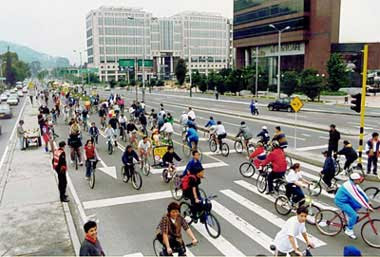
Jeju Island's 'Car Free Day' celebration reeks of this same good-intentioned, misunderstood sentiment plaguing South Korea. This year (on November 12) Jeju Island celebrated it's first 'Car Free Day.' Those familiar with 'Car Free Day' are certainly referencing famous images from cities like Bogotá, Colombia, where full city streets are completely empty of cars, as nearly every citizen walks or rides bikes for the entire day. Certainly Bogotá's 'Car Free Day' success was not born over-night, and we cannot expect Jeju's first 'No Car Day' to resemble anything like an entire car-free city.

Bogota, Colombia's Car Free Day

And while I don't have any unrealistic expectations of Jeju's first 'Car Free Day' success I do think people should just be honest about their participation in the event. Last week, as November 12th neared, I imagine that news-gathering principals and vice principals alike heard word of the upcoming event, and so instructed their teachers and school staff to participate in 'Car Free Day'. That morning, I walked through the carpark of my school, and saw a mere 3 cars parked in the massive carpark (I teach at Jeju's largest elementary school, which is attached to a middle school, both of which share this parking lot). Forgetting that is was 'Car-Free Day', I just assumed I was a little early for school (as I am usually a little late). Later, when I realized that it was 'Car-Free Day', I was quite impressed with the teachers and staff at my elementary school for taking it so seriously.

That afternoon, when my partner came home from his school. He too told the story of the empty parking lot he noticed as he parked his motorbike, thinking, 'Sweet, maybe everyone's off on a field trip today!" Yet, when he walked in the school, it was buzzing as always. He asked his co-teacher why the parking lot was empty and she told them that all the teachers had to park in the neighborhood up the hill from the school, because it was 'Car Free Day' and the principal told them not to drive to work. Essentially then, these teachers had not only driven their cars to work on 'Car Free Day', many of them had used extra gas to drive farther uphill in order to secure a parking spot that was far away enough from the school to appear as though they'd walked or used public transportation to arrive at school. And all in order to appease the principal (who, in all likelihood also parked his car up the hill)!

I can only assume that the teachers at my school also hid their cars in the neighborhoods around the school. Saving-face is a Korean malady, that, for the sake progression in this country, I can only hope is one day cured (actually cured, not just given a shot in the bum told to 'take a rest').


Friday, July 16, 2010

Showing Off

Yesterday afternoon, when the incredibly pleasant two Korean teachers, with whom I share the English office, received a phone call that caused them to pass the phone between the two of them, and make anxious, gloomy-looking faces in my direction, I knew something ridiculous was a-brewing.

"Ah-di-ael, ummm, sorry, but the, ummm, the director of the POE won the election in June."
"Riiiiight?"
"So the Educational TV in Jeju will do a news story about him. And he really pushes the development of English."
"Riiiiight?"
"And so they want to video tape your class tomorrow to show how he is doing a good job pushing the English curriculum."
"That's about right."

I suppose it's fair enough that the director of the Educational Office in Jeju wants to show off Jeju's best elementary school full of fluent English-speakers. Not only are many of them fluent in English; their parents are Jeju's richest; most of them have been overseas; nearly all of them take English classes 5 days a week at local hagwans (privately-funded 'extra' schools), which many of them have attended since their toddler days, learning Korean and English simultaneously. I suppose that's fair enough. But honestly is the wealth and opportunity of Halla Elementary's rich families any reflection of a job-well-done on the part of the re-elected director of the Educational Office? Why do I even pose questions like this anymore, one would think I knew better after all my time in Korea.

Today was my final day of Friday classes, meaning that my lesson plan outlined 5 minutes of 'Good mornings,' 5 minutes of 'Simon Says,' 25 minutes of 'Review Jeopardy,' and 5 minutes of 'Good-byes.' A lesson plan, surely not adequate for showing off Jeju's richest and finest young English speakers. My co-teachers, aware of this, argued my case to the Vice Principal, suggesting that the TV station use my prepared videoed class from weeks before. And suggested as well that a plethora of videos, including videos of last year's award-wining-teachers (of which I am not) sat in the Educational Office.

To this they answered, that the re-elected director of the Educational Office (let's call him Mr. Kim for simplicity, and for the overwhelmingly likelihood that his name is indeed Mr. Kim) insisted upon making a new video, shot by real TV cameramen, with a real TV camera.

"So, Ah-di-ael, sorry, but we have to make this video. It is okay?"
They don't really mean, 'It is okay?' They mean, "Ah-di-ael, you have no choice but to make the video because we live in a polite hierarchical society where we have to do many nonsensical things just because people in higher positions than us have requested it. But we cannot demand it of you with our words because we are too polite."
"Sure, I'll do the video, but I'm not going to plan anything new. I'll just use one of my old lesson plans, and those poor students in 5-2 will have to repeat a lesson, instead of playing a review game."
"Yes, that's a good idea!"
Is it, really?

This morning, when I arrived to school, my co-teachers informed me that all my other classes were canceled, because they were unaware of the arrival time for the camera crew. We were to sit and wait until we heard that the camera crew was coming. Also, they added that the class needed to be filmed in the English room. A high-tech, expensive, poorly designed classroom with long desks and chairs too big for children, that I opted not to use all semester because of its clumsy structure.

As I was rearranging the clumsy room this morning, I couldn't help but laugh at the ridiculousness of a re-elected director of the Educational Office trying to show off the English ability of students who didn't learn the majority of their English through the public school system. And doing so by forcing a non-award-winning English teacher to make a professional video on her last day of 'Jeopardy Review' class, which she then changed to reteach a prepared lesson to children in a clumsy room she'd never used.

And furthermore, since all my other classes were canceled, no actual English learning took place in Halla Elementary this morning, and all for the sake of showing off yet another Mr. Kim!


Friday, April 23, 2010

Flying...

I currently love overseas traveling. When I was younger, I even loved the physical airplane ride. When I was 19, and could curl my little 19 year-old self into a ball and sleep for the entire 10 plus hours with my head gently resting atop my bent knees through the beverage service, the dinner, the late night beverage service, the continual water offerings, the breakfast, and even the landing, I just couldn't understand how anyone could loathe flying.

Even into my early twenties when I couldn't sleep for the length of of the entire plane ride, I'd find a good movie to watch on the small screen placed on the backs of all seats; conveniently economy-class airplane technology was developing alongside my ever increasing inability to sleep in a curled up ball. And as long as I remembered to tell the travel agent to order veggo meals for me, the dinners were never as awful as popular culture purported. After my hot veggo dinner and complementary bottle of wine for one, I could easily fall asleep to whatever movie I'd chosen, only to be awoken by the smells of food carts full of breakfast, and at least one veggo breakfast for me.

I've not taken residence in the states for six years now, so in order to return home, it has to be an international return home. And since nearly all of my friends here in South Korea are also Native English Teachers, oceans away from their families, international flying is a common, well-researched, topic of interest often discussed around dinner tables. The general consensus reassured by every one of these conversations is that all airlines owned and run by any North American is inferior to all Asian airlines in nearly every possible way.

Airport services. Many Asian International airports have massage rooms, massage chairs (some are even FREE massage chairs), movies to watch, shower rooms, and some even have exercise rooms for the long layover-er. Oh, and these services are offered to everyone, not just those lucky enough to carry some Super Elite Frequent Flyer card with free entry access to places as choice as Narnia. Internet in many Asian airports is also free, and if not free, at least it's an affordable way to spend an hour or so of your time. I once accidentally spent $25.00 of my last $45.00 US Dollars in LAX within hour 1 of my 7 our layover using a ridiculous priced internet service on my laptop (In Korean airports, even for domestic flights, you can use airport computers for free internet services).

Bag checking. On my last trip from Chicago back to Korea in February of this year, the large fella working at the Baggage Check looked at my things, as they made their way through the rubber flaps on the secure side of the conveyor belt, "We got another one who can't listen and follow directions," he said. "Excuse me?" I asked, "Have I done something wrong?" He gruffly explained that just moments before he'd yelled to everyone that they needed to keep their shoes OUTSIDE the buckets. I irritatedly apologized and explained that it was really hard to hear anything as so many things were being yelled at us back there. Furthermore, it's difficult to know just what to do, as every American airport seems to have different rules, though the same sense of condescending righteousness among its workers. As I grabbed the rest of my things, anger boiled up inside me, and I couldn't resist telling him that I didn't appreciate him treating me as though I were a child, and that I'd done a fair amount of International travel, and no other nation had airport workers as rude as the Americans. He then told me, "That's cause American airports do it right." Riiiight, I thought.

On a recent weekend trip to Seoul from Jeju, I had failed to take my mini swiss army knife off my key chain, and as I didn't check any baggage, it was scanned, identified as dangerous and I was asked by a very pleasant employee to go back to the counter and check it through. When I showed him my boarding pass and told him that I didn't have enough time, he escorted me downstairs to my gate, handed the knife to a steward on my flight, who put it in an envelope and then assured me that I'd get it back in Seoul. If only I could have expressed in Korean that the 'American airports do it right' then these incredibly helpful, patient Korean airport workers could have seen error of their ways.

Service. Just last weekend I had to change my flight departure date for a domestic flight from Seoul to Jeju, and because the Sunday flight was originally more than the Monday flight that I was changing to, there was no fee at all. Had my flight changing happened in the states, I'd be sure to pay a fee, regardless of price difference, possibly even more than the price of my ticket.

Smiling, attractive stewards, stewardesses and counter people. In Asia, only happy people, or people who fake happy well, are allowed to serve you on an airplane or in an airport. I'll refrain from describing the physical appearance of most of the stewardesses on North American international flights, but let's just say, if they smiled more I wouldn't notice just how fat they are.

The days of curling up in a ball and sleeping for the entire course of an international flight are over for me. I increasingly find it difficult to sleep much at all on flights these days, and courteous, smiling stewards and stewardesses are becoming more and more important to me. One day, when I move away from Korea and enter life back in the West, I'm sure I'll sorely miss Asian airplanes, airports and staff.


Tuesday, January 26, 2010

Korean Traffic Pandemonium


I’m certainly not the world’s best driver. In my first few teenaged years of licensed-driving, I crashed the front of my car (well, the car my parents let me drive) into a brick flowerbed on a rainy slippery afternoon; backed the old thing into massive trash receptors denting my trunk; and pulled out in front of a friend’s mom’s van the afternoon of junior year prom, forever sealing the driver’s side door, forcing window-climb entries a la The General Lee from ‘The Dukes of Hazzard.’

However, in my 12 years or so of driving, I’ve not hit, smashed, slid, hydroplaned, fender-bendered, or even bumper-tapped anything since that wayward junior prom afternoon. This dramatic drop in minor accidents can be attributed almost exclusively to the fact that I stopped driving much past my high school days.

Eleven months ago, however, after living on Jeju Island for a year, I bought an old, beaten, scuffed-up, gas-guzzling car from another foreigner. And while I cannot say that I drive the beast regularly (as I also own and drive a small 125cc motorbike, which is better for gas, money, convenience, and anxiety), I can say, that when I drive, I am regularly stressed, irritated, fist-clinched and spouting a variety of cleverly-phrased (or I think so, at least) curse words!

There are various reasons attributing to Korea’s chaotic driving culture; for example, its relative short history. Cars were not a family staple in Korea until about 20 years ago. Now, every family has at least one car, and at least one driver, possibly self-taught, and almost certainly not a product of heavy childhood car-culture like that found in the West. Korean adults today didn’t grow up climbing in and out of cars, like most Westerners. My grandparents knew how to drive, and so taught my parents, and so taught me. I had 2 generations of driving-knowledge passed down to me in my youth, whereas many of the adults driving in Korea today possibly had no car experience before they began driving.

Furthermore, and possibly also because of its brief history, driving common sense is that of fiction here in Korea. I imagine that most Koreans were taught to drive with one hand so as to keep their other hand free for phone duty. I’ve seen a woman with her baby on her lap, driving her car at night, dome light on so she can see the lip liner she’s applying, with her cell phone wedged in between her shoulder and ear. Not only is it still legal to talk on your phone while driving, the Korean government just passed a law maintaining the rights of taxi drivers to keep satellite TVs on their dashboards, so as to keep the taxi drivers entertained when without a fare, despite a few crash-related deaths due to distracted, ‘entertained’ taxi drivers.

‘Blind spots’ has no translation in Korean (at least that I know of), as driving instructors have no lectures on the subject. It is common to drive in Korea and have the car in front of you completely cut you off, for if they cannot see you in their mirror, you do not exist! A friend of mine relayed a story about a young Korean woman, riding in the passenger seat of a Westerner’s car. My friend was sitting in the backseat, and as the Western-driver, when changing lanes, kept checking her blind spot for approaching cars, the Korean woman also turned around, with a very confused look on her face. When my friend and the Korean woman were alone, the Korean woman confided her confused question, “Your friend is a good driver, but why does she keep turning around all the time? What is she looking for? She should keep her eyes on the road in front of her.”

In Korea, it is perfectly normal to park your car, on a main street, if you need to run into a shop, a bank, or your home (and nap for hours). It seems that if one puts hazard indicators on, it’s no hold’s bar on any parking and driving laws one may violate. Within my very first hours of arriving to Korea, a Korean co-worker picked me up from the airport, and drove me into Seoul. When we missed our exit on the massive interstate, he simply slowed the car a little, pushed on his indicators, and reversed from 60kph on the interstate to make it back to our exit.

To further compound this young, uninformed driving culture, there is a complete lack of law enforcement where common (though serious) driving violations are concerned. When traffic laws like running red lights, parking on busy main streets, pulling out across three lanes of traffic to turn, u-turning on main roads into on-coming traffic, (the chaotic list could continue forever, I fear) are infringed and the local police happen to be there, they do nothing. A friend of mine, while sitting at a long, quiet red light, checked both directions of traffic and slowly pulled through the light, only to realize that she’d not checked the car next to her before doing so. When the cops watched as she ran the red light, they whooped the siren for a moment, and then remained stopped at the red light, as she slowly drove away.

A young driving culture and a lack of law-enforcement can account for a certain degree of the Korean traffic pandemonium, but something must be said for the uncanny similarities between their driving and the way Koreans walk, line-up, and organize themselves in open spaces. In the same way that it is not rude in this culture for an adjuma (an older woman) to bump into your back, elbow your side, groan ‘Bali Bali’ (Faster!) at you then speed past you as you try to enter the front doors at Lotte Mart (Korea’s Target), so too is it socially acceptable to side swipe someone’s parked car, knocking their side mirror off, and scuffing their doors then simply drive away, guilt-free.

Korea’s most effective driving/parking solution to the seemingly unsolvable chaos, is that of posting a telephone number on the dashboard of all cars. Since the police rarely ticket illegally parked cars, and tow-trucks cannot tow un-ticketed cars, the only way to move a troubling vehicle is to ring the person it belongs to, ask them to come outside, and park their car elsewhere!

If only this were the status quo of America, 1998. I very easily could have left my car in that brick flowerbed of my neighbor’s yard, ensuring my phone number could be easily viewed from the windshield and awaited their pleasant phone-call request for my car's removal!


Wednesday, December 2, 2009

Rebel Hair Woe

I had this wee ingrown hair in my armpit that I noticed about a month ago. It didn't really hurt, and I wasn't too worried about, though I did try to squeeze it out and even subjected my boyfriend, tweezers in hand, to have a go at removing the little annoying hair. Still, after reading a bit on that new thing we call the Internet, I learned that ingrown hairs really don't get better on their own. Either they always stay the same or they get infected, worsen, and cause heaps of problems. So in my proactive, 'I don't want heaps of problems later' manner, I used one of my mornings off work to get the little curly fella checked out.

Most doctors in Korea speak English decently (though I have been told by an acupuncturist that my neck pain is 'cereal'). For this particular affliction, however, I wanted to clearly explain my problem and ensure he knew what to do for ingrown hairs. Furthermore, if he was sick that day of med-school where they explained ingrown hair procedure, I knew of a great website we could read together (in English) that outlined, what seemed to me, a very easy method of exfoliating, tweezering and yanking to rid my armpit of her rebel-hair woe!

Unaware of skin doctors capable of speaking this advanced level of English, I headed toward the foreigner clinic inside a hospital not too far from my house. When I arrived for my very first visit to this English-welcoming clinic, I was disappointed to find that the nurse couldn't say much past, "Your name?" and "Your ID card?" Though she did try her best, and continued to repeat "Dok-tah la-bol-la-tol-li," which obviously means that the doctor is in the laboratory, though I was having troubles discerning this obvious statement as I sat in front of her, slowing duplicating her constant repetition. "Dok-tah la-bol-la-lol-li?" I said. Now, it was my turn to sound stupid as I explained in my poorly spoken, pigeon Korean, that I was sorry, but I didn't know what she was saying. She smiled, picked up the phone, dialed a number, huffed a bit, set the phone down, and asked me, in Korean, to wait.

40 minutes later, she handed me the phone.
"Hello?" I asked.
"Hi. I am the doctor."
I explained everything about my renegade armpit hair. And he explained everything about 'Dok-tah la-bol-la-lol-li.' He said, "Ok, well I am in the laboratory all day today, and will not come to the foreigner clinic. So I suggest you go see a skin doctor at another smaller clinic."
"Rightio, Doc, but I came here because I wanted to communicate clearly in English."
"Yes, well I suggest you go to a skin doctor in another clinic, who speaks English." explained doctor obvious!
"Sure, well do you know of any English-speaking Skin Doctors?" I asked.
"Ummmmmmm no. Do you read Korean?"
"Yes, but how will I find a skincare clinic with a doctor who speaks English?"
"Ummmmmm, I suggest that once you find a clinic, go inside and ask the doctor."

I laughed out of frustration and at my obtuseness, told him I could figure things out on my own, and hung up with the ever-so-helpful Dr. Obvious. I left the hospital angry, and marched back toward my house, where I remembered seeing a building full of different specialized clinics. My cell phone's Korean/English dictionary translates quite a bit better from Korean to English, so as I stood in front of the 5 story building, I typed in the names of each of the clinics. Floor 5 was a skincare clinic. Golden. Now to ask the question of English!

Luckily enough, on my very first 'find an English speaking Skincare Doctor' attempt, the doctor spoke English, as did one of his nurses. So he set me up with some minor laser surgery, and fried that rebel curly-hair out of her cyst-like home! During the extremely brief procedure, a nurse stood above me with a hose to suck out the smell of burning flesh. However, the hose didn't quite reach to my armpit, so she placed it next to my nose, ensuring that neither the doctor nor the nurse could capture the alluring whiff of my blazing armpit, but failing to prevent the smell from wafting up my nose! Fortunately, I endured only moments of the quesying odor, as laser-burning small ingrown-hair cysts takes merely moments.

Relieved that I no longer had to breath in my own burning flesh, I redressed, and made my way to the check-out counter, where I paid my whopping $12 bill. Realizing, that despite the frustrating conversation with Dr. Obvious, searching for an English-speaking doctor on my own, and inhaling my own singeing flesh, the morning's events were far more pleasurable than they could have been back home. All that hassle is worth a mere $12 bill. With seriously flawed healthcare 'reform' bills back home, I'm happy to be in government-funded healthcare-for-all (even for English teachers!), Korea.